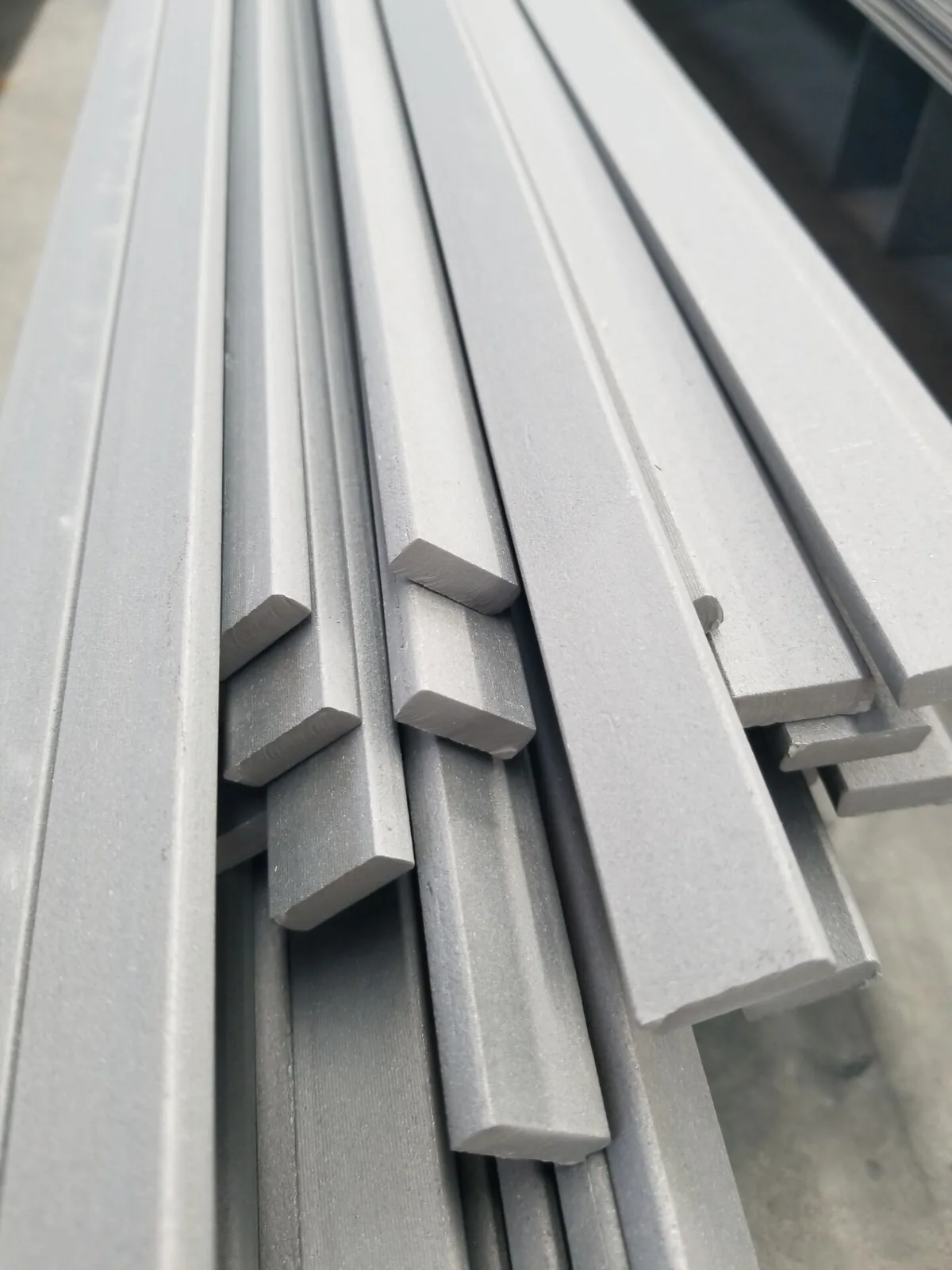
What Grade 1 is
Grade 1 (UNS R50250) is unalloyed titanium with the tightest interstitial limits of the CP grades: iron capped at 0.20% and oxygen at 0.18%. Those low limits are what make it soft. Every added hundredth of a percent of oxygen strengthens titanium and costs ductility, so Grade 1 sits at one end of the CP range and Grade 4 at the other.
The practical consequence is formability. Minimum elongation is 24% against Grade 2's 20%, and bend radius follows elongation. Where a Grade 2 blank would crack on a tight draw, Grade 1 usually survives it. The trade-off is strength: 240 MPa minimum tensile against 345 MPa, roughly two-thirds.
Chemical composition
| Element | Limit |
|---|---|
| Nitrogen, N | 0.03 |
| Carbon, C | 0.08 |
| Hydrogen, H | 0.015 |
| Iron, Fe | 0.20 |
| Oxygen, O | 0.18 |
| Titanium, Ti | Balance |
Composition limits and mechanical values below are the published requirements of the referenced ASTM specification. They state what the standard requires — they are not the measured result of any particular heat or lot, and they are not a guarantee of what a given order will return.
Mechanical properties
| Property | Minimum value |
|---|---|
| Tensile strength | 240 MPa (35 ksi) |
| Yield strength, 0.2% offset | 138 MPa (20 ksi) |
| Elongation in 2 in / 50 mm | 24% |
| Reduction of area (bar, ASTM B348) | 30% |
| Typical density | 4.51 g/cm³ (reference value) |
Requirements differ slightly between product specifications. Your order is quoted and certified against the standard and revision you name, and the values on the mill test report are the ones that apply.
Grade 1 vs Grade 2
| Aspect | Grade 1 | Grade 2 |
|---|---|---|
| Tensile strength, min | 240 MPa | 345 MPa |
| Yield strength, min | 138 MPa | 275 MPa |
| Elongation, min | 24% | 20% |
| Formability | Best of the CP grades | Very good, slightly less forgiving |
| Corrosion resistance | Equivalent in practice | Equivalent in practice |
| Price level | Depends on form, size and order — ask for a quotation | Depends on form, size and order — ask for a quotation |
The two grades corrode in much the same way, because corrosion resistance comes from the titanium oxide film rather than from alloy content. So the choice is almost never about corrosion: it is about whether the forming operation needs Grade 1's ductility, and whether the design can live with its lower strength. If the answer is “the design cannot” and the draw is nevertheless severe, the material is usually annealed between forming stages instead of specifying Grade 1.
The full decision method is set out in the titanium grade selection guide.
Forms we quote in Grade 1
Plate & sheet
The main Grade 1 form — thin sheet for deep drawing, plate for vessel linings and formed heads.
Plate & sheet → →
Tube & pipe
Heat-exchanger and condenser tube where maximum ductility aids expansion into the tube sheet.
Tube & pipe → →
Wire
Fine wire for mesh, weaving and chemical-process packing.
Wire → →
Typical uses
- Deep drawing and spinning — the classic Grade 1 application, where the draw depth cannot be achieved in Grade 2.
- Chemical process vessels and linings — where the duty is oxidising but not erosive and the wall thickness is set by fabrication rather than pressure.
- Heat-exchanger tube — specified where tube expansion into the tube sheet requires high ductility.
- Anode baskets, hooks and jigs — a long-standing electroplating use that trades strength for formability and corrosion life.
- Architectural cladding — where large flat panels are formed cold and distortion matters.
Drawing or forming Grade 1? Send the part geometry, thickness and the standard you are specifying — we will confirm what can be quoted.
WhatsAppSend your specificationRequest Grade 1 titanium
Tell us the form, dimensions, quantity and the standard reference. If you are choosing between Grade 1 and Grade 2, describe the forming operation and we will tell you which is normally specified.
WhatsApp +86 157 0603 0959 · WhatsApp +86 151 9196 1431 · tockson@163.com