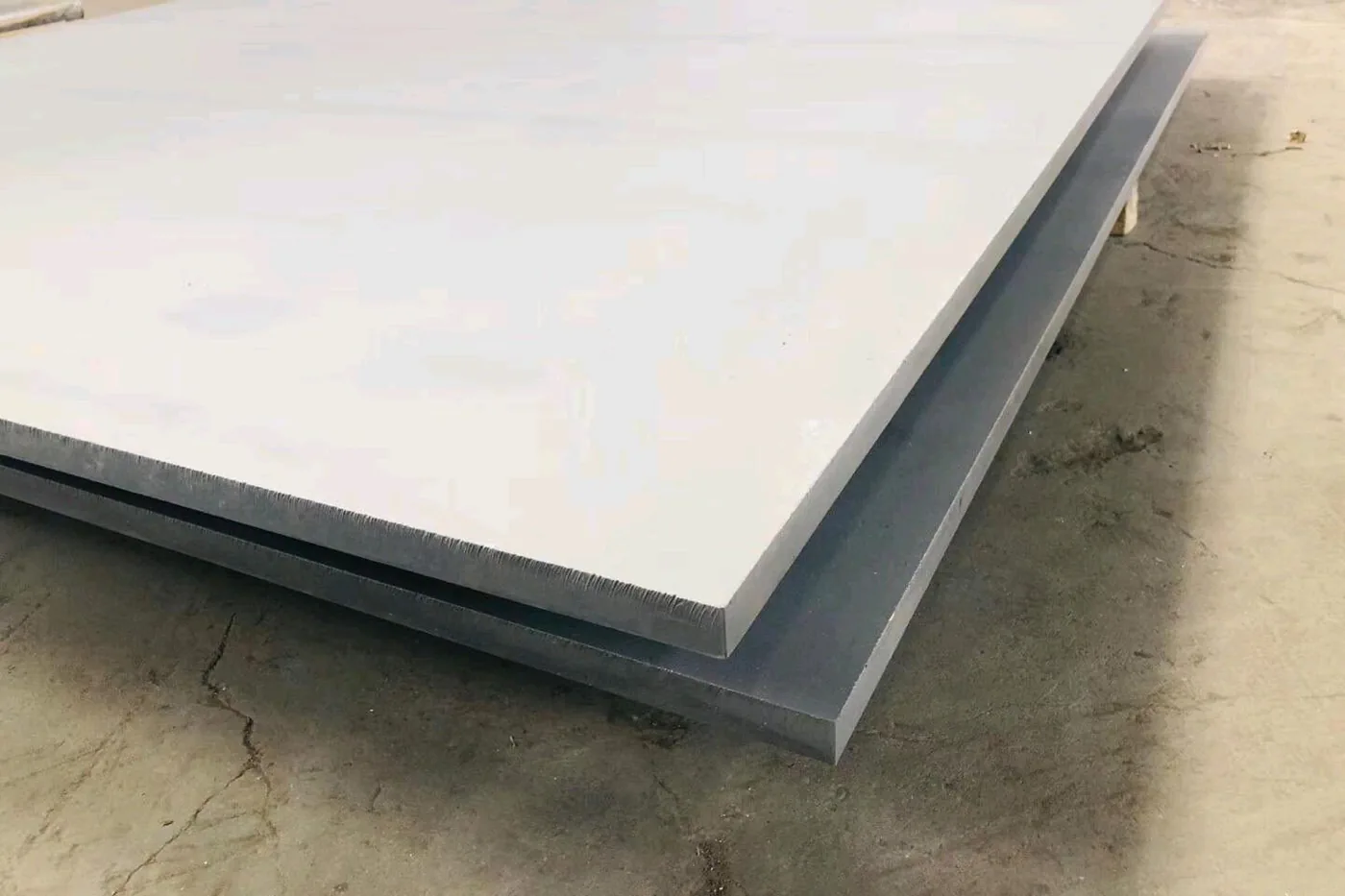
What Grade 7 is
Grade 7 (UNS R52400) is commercially pure titanium to the Grade 2 chemistry with palladium added in the range 0.12–0.25%. It is essentially Grade 2 mechanically: same 345 MPa minimum tensile, same 275 MPa minimum yield, same 20% minimum elongation, same formability, same welding practice.
Everything about Grade 7 follows from the palladium, and nothing about it follows from strength. If you need strength, Grade 7 is the wrong answer. If Grade 2 is corroding and the alternative is a nickel alloy or tantalum, Grade 7 is frequently the cheapest fix.
Why palladium matters
Titanium resists corrosion because a thin oxide film forms spontaneously on its surface. In oxidising environments that film repairs itself instantly, which is why Grade 2 performs so well in seawater, nitric acid and wet chlorine. In reducing environments there is no oxidiser available to re-form the film once it is damaged, and attack begins.
Palladium is a noble metal. Small amounts dispersed through the titanium surface act as cathodic sites that shift the alloy's corrosion potential into the passive region and markedly lower the rate of anodic dissolution. The practical result is useful resistance in dilute reducing acids and in hot chloride crevices that Grade 2 will not tolerate.
Chemical composition
| Element | Limit |
|---|---|
| Palladium, Pd | 0.12 – 0.25 |
| Nitrogen, N | 0.03 |
| Carbon, C | 0.08 |
| Hydrogen, H | 0.015 |
| Iron, Fe | 0.30 |
| Oxygen, O | 0.25 |
| Titanium, Ti | Balance |
Composition limits and mechanical values below are the published requirements of the referenced ASTM specification. They state what the standard requires — they are not the measured result of any particular heat or lot, and they are not a guarantee of what a given order will return.
Mechanical properties
| Property | Minimum value |
|---|---|
| Tensile strength | 345 MPa (50 ksi) |
| Yield strength, 0.2% offset | 275 MPa (40 ksi) |
| Elongation in 2 in / 50 mm | 20% |
| Typical density | 4.51 g/cm³ (reference value) |
Identical minimums to Grade 2. If your design was sized for Grade 2, the mechanics do not need revisiting when moving to Grade 7 — only the corrosion check does.
Grade 7 vs Grade 2 — when the premium is worth paying
| Situation | Grade 2 | Grade 7 |
|---|---|---|
| Seawater, chloride cooling water, ambient | Correct choice | Unnecessary cost |
| Nitric acid, most oxidising acids | Correct choice | Unnecessary cost |
| Dilute hydrochloric or sulphuric acid | Attacked | Often the economical upgrade |
| Hot chloride crevice under a gasket or deposit | Crevice attack likely | Much improved |
| Reducing conditions with no oxidising species present | Poor | The reason this grade exists |
| Budget-driven structural work | Preferred | Premium not justified |
The rule of thumb used by plant engineers: stay with Grade 2 until you have a specific reason to doubt it, then move to Grade 7 only for the surface or component that actually sees the severe duty. It is common to build the vessel from Grade 2 and line, clad or fabricate only the critical internals in Grade 7.
Where the duty is hot seawater or brine rather than acid, the comparison that matters is usually Grade 12 rather than Grade 7 — see Grade 12 titanium.
Typical service
- Chemical process vessels and columns handling dilute reducing acids; see chemical processing.
- Reactor internals, agitators and dip pipes where a single component sees the aggressive phase.
- Flanges and crevice-forming joints where gasket faces are the failure point.
- Tube and pipe in mixed acid streams where the stream swings between oxidising and reducing.
Forms and standards
Grade 7 is quoted in plate and sheet to ASTM B265 / ASME SB265, and in tube to ASTM B338. Welded fabrication uses matching Grade 7 filler or Grade 16 / 17 consumable depending on the specification called up. Supply in any specific size and form is confirmed on inquiry.
Availability, size range and lead time for a specific grade and form are confirmed in the quotation — please contact us for confirmation.
Tell us your medium, concentration and temperature — we will advise whether Grade 2, Grade 7 or Grade 12 is the grade usually specified.
WhatsAppSend your specificationRequest Grade 7 titanium
Describe the service rather than simply naming a grade: medium, concentration, temperature and whether crevices are present. That is what determines whether Grade 7 or Grade 12 applies.
WhatsApp +86 157 0603 0959 · WhatsApp +86 151 9196 1431 · tockson@163.com