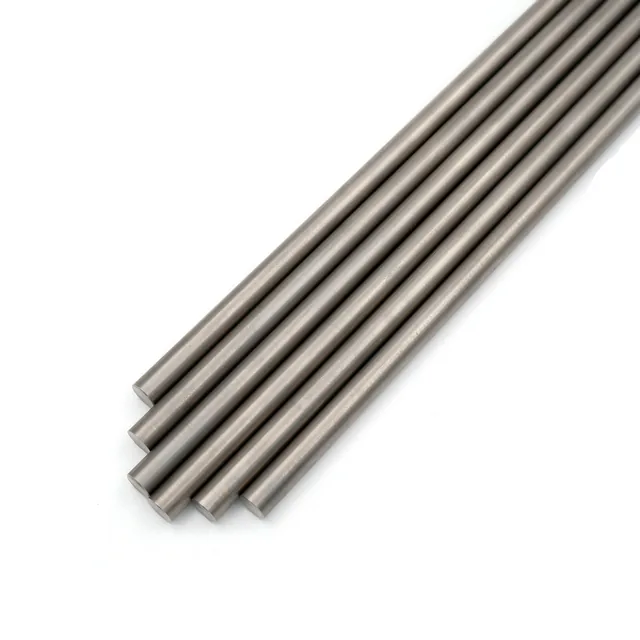
What Grade 23 is
Grade 23 (UNS R56401, Ti-6Al-4V ELI) shares Grade 5's aluminium and vanadium ranges. The difference lies entirely in what is kept out: oxygen is limited to 0.13%, hydrogen to 0.0125% and iron to 0.25%, against Grade 5's 0.20%, 0.015% and 0.40%. That tighter chemistry needs additional melting control, and it is reflected in the price.
Interstitials strengthen titanium but reduce its tolerance for defects. Pulling them down therefore costs a little strength — minimum tensile drops to 828 MPa against Grade 5's 895 MPa — and buys toughness and ductility. In service where a flaw, a notch or a cryogenic temperature matters, that trade is deliberate.
Interstitial control explained
“Extra-low interstitial” refers to the small elements that sit in the gaps of the titanium lattice: oxygen, nitrogen, carbon and hydrogen. Oxygen and nitrogen are potent solid-solution strengtheners; hydrogen is harmful in quantity because it can form hydrides and embrittle the metal; carbon must be controlled to avoid carbide formation.
- Oxygen 0.13% max vs 0.20% — the headline difference, and the main driver of improved ductility and toughness.
- Hydrogen 0.0125% max vs 0.015% — tighter control against hydride-related embrittlement.
- Iron 0.25% max vs 0.40% — restricted because iron can segregate and form brittle regions.
- Carbon 0.08% max and nitrogen 0.05% max — controlled for the same reasons.
Chemical composition
| Element | Requirement |
|---|---|
| Aluminium, Al | 5.5 – 6.5 |
| Vanadium, V | 3.5 – 4.5 |
| Iron, Fe | 0.25 max |
| Oxygen, O | 0.13 max |
| Carbon, C | 0.08 max |
| Nitrogen, N | 0.05 max |
| Hydrogen, H | 0.0125 max |
| Titanium, Ti | Balance |
Composition limits and mechanical values below are the published requirements of the referenced ASTM specification. They state what the standard requires — they are not the measured result of any particular heat or lot, and they are not a guarantee of what a given order will return.
Mechanical properties
| Property | ASTM B348 (annealed bar) | ASTM F136 (wrought annealed) |
|---|---|---|
| Tensile strength | 828 MPa (120 ksi) | 860 MPa (125 ksi) |
| Yield strength, 0.2% offset | 759 MPa (110 ksi) | 795 MPa (115 ksi) |
| Elongation in 2 in / 50 mm | 10% | 10% |
| Reduction of area | 25% | 25% |
Note that the two widely referenced specifications set different minimums for the same nominal material. Always quote against one named standard and revision, and read the mill test report against the specification you ordered to.
Grade 23 vs Grade 5
| Factor | Grade 5 | Grade 23 ELI |
|---|---|---|
| Tensile strength, min (B348) | 895 MPa | 828 MPa |
| Yield strength, min (B348) | 828 MPa | 759 MPa |
| Elongation, min | 10% | 10% |
| Maximum oxygen | 0.20% | 0.13% |
| Fracture toughness | Standard | Improved — the reason for specifying ELI |
| Ductility in practice | Adequate | Better margin above the minimum |
| Cost | Lower | Higher, reflecting extra melting control |
| Typical specification driver | Strength-limited general engineering | Damage tolerance, cryogenic service, tightly regulated sectors |
Grade 5 is covered in detail on the Grade 5 page.
Medical and aerospace context
Grade 23 is heavily referenced in implant and aerospace work, and it is worth separating what is a material standard from what is a qualification. ASTM F136 is the standard specification for wrought Ti-6Al-4V ELI intended for surgical implant manufacture, and it sets chemistry, mechanical properties and microstructure requirements. Referencing F136 on a purchase order is a material requirement.
Forms we quote
- Round bar — the form most often requested in Grade 23; see bar & rod.
- Plate and sheet — quoted where size can be produced; see plate & sheet.
- Wire — enquired for small precision components; see wire.
Availability, size range and lead time for a specific grade and form are confirmed in the quotation — please contact us for confirmation.
Enquiring about Grade 23? Send the standard and revision, product form, size and intended use — we will tell you plainly what we can quote.
WhatsAppSend your specificationRequest Grade 23 titanium
State the specification you are ordering to, including revision, along with form, dimensions, quantity and intended application. Where a qualification is involved, describe it in the first message rather than later.
WhatsApp +86 157 0603 0959 · WhatsApp +86 151 9196 1431 · tockson@163.com