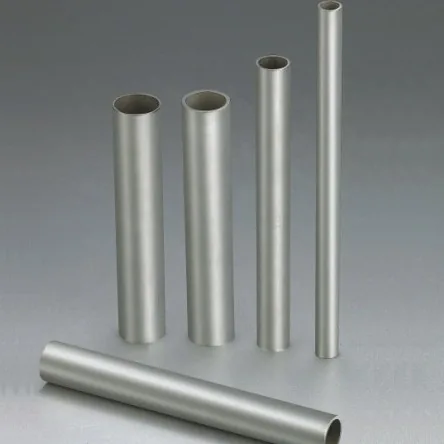
Tube versus pipe — what buyers actually mean
In everyday enquiry language these words overlap, and asking a buyer to use them precisely usually wastes time. But they do carry distinct meanings on a specification, and knowing the difference prevents an expensive mismatch.
| Term | How it is specified | Governing specification |
|---|---|---|
| Tube | By outside diameter and wall thickness (or by OD and gauge) | ASTM B338 for condenser and heat exchanger tube |
| Pipe | By nominal pipe size and schedule number | ASTM B861 seamless pipe, ASTM B862 welded pipe |
| What actually matters | OD, wall and length — these define the part | Whichever standard your drawing names |
Seamless versus welded — the decision
| Factor | Seamless | Welded |
|---|---|---|
| Manufacture | Extruded or pilgered from billet | Rolled from strip and welded along the seam |
| Typical use | Heat exchangers, condensers, pressure tube | Larger diameters, lower pressure, structural use |
| Wall uniformity | Good, though eccentricity is possible | Concentricity generally good from strip |
| Cost for given size | Higher | Lower for larger sizes and long runs |
| Seam-related risk | None | Seam is the critical region and must be tested |
The conventional answer for heat transfer is seamless, because there is no seam to corrode preferentially or fail. Welded tube becomes attractive at large diameters where seamless production is expensive.
Commonly ordered OD × wall combinations
| Application | Typical combination | Note |
|---|---|---|
| Heat exchangers and condensers | OD 20 – 60 mm, wall 0.6 – 3.0 mm | Thin wall for heat transfer; the largest category |
| Small-bore instrumentation and capillary | OD 0.8 – 6 mm | See the tube product page for the fine range |
| Process pipe | NPS-based sizes to schedule | Send NPS and schedule rather than converting |
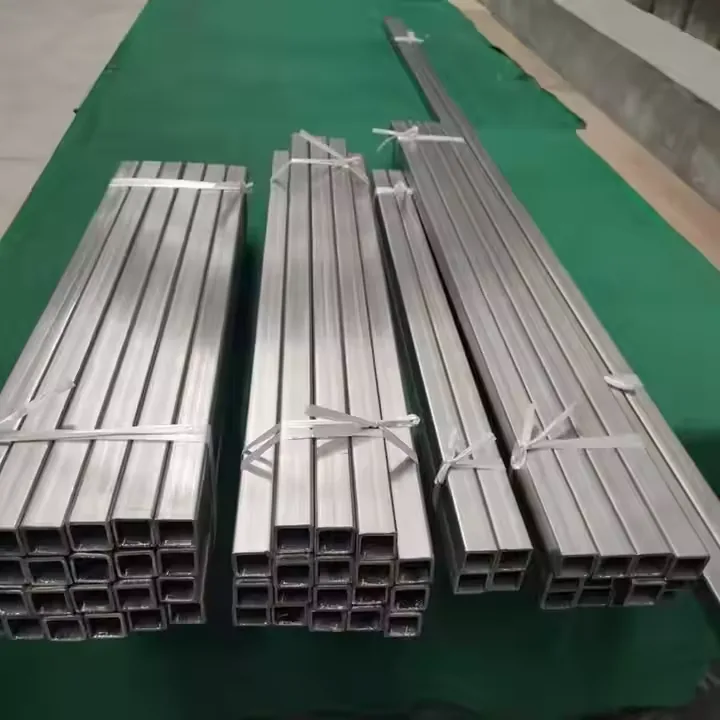
| Structural and marine runs | Square, rectangular and round | Including cold bends from spool drawings |
Availability of a specific combination depends on the mill programme and is confirmed per enquiry.
Testing explained
| Test | Principle | What it catches |
|---|---|---|
| Hydrostatic | Pressurising the tube with water to a set pressure and holding | Through-wall leakage, gross defects, poor ends |
| Eddy-current | Inducing currents in the wall and reading their disturbance | Surface and near-surface discontinuities along the length |
| Ultrasonic | Sending sound through the wall and reading reflections | Wall thinning, inclusions, laminar defects in heavier wall |
| Air-under-water | Pressurising while submerged | Leakage through pinholes in thin wall |
| Flattening / flare | Deforming a sample to a specified degree | Ductility and soundness of the material |
Which tests are mandatory versus optional depends on the standard and the order. Specify them explicitly: a test not called up on the order is a test not performed.
Length tolerance and end preparation
- Fixed lengths are supplied to a stated tolerance. Give the tolerance your fabrication can accept — asking for tighter than needed adds cost for no benefit.
- Mill lengths or random lengths are cheaper and suit orders where tube is cut down afterwards anyway.
- End finish: square cut and deburred is the default. Bevelled ends are supplied for butt welding; state the angle.
- Cleanliness: for heat exchangers, state whether the bore must be free of lubricant and debris, since tube-sheet assembly assumes it.
Theoretical weight per metre
The figure below is theoretical. It is useful for estimating freight and rough material cost, and it is not the weight you will be invoiced on, because actual wall thickness is never exactly nominal.
Calculation
Weight per metre (kg/m):

    W = (OD - t) x t x 0.0031416 x density

    OD       = outside diameter, mm
    t        = wall thickness, mm
    density  = 4.51 g/cm3 for commercially pure titanium
              = 4.43 g/cm3 for Ti-6Al-4V (Grade 5)

Example, Grade 2 tube OD 25.4 mm, wall 1.5 mm:

    (25.4 - 1.5) x 1.5 x 0.0031416 x 4.51
    = 23.9 x 1.5 x 0.0031416 x 4.51
    = 0.508 kg/m approximately

This is a theoretical figure for estimation only.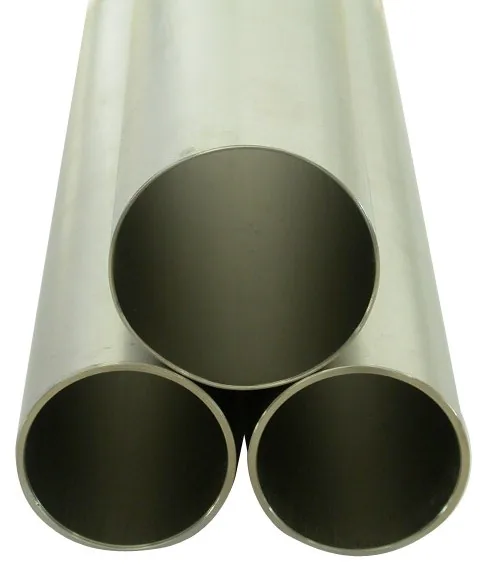
Mistakes that cost money
- Not stating the wall. An enquiry that gives OD and length only cannot be quoted for a heat exchanger. Always give both.
- Assuming the standard covering NDT. If your specification needs eddy current, say so. Standards do not automatically require every possible test.
- Converting NPS to millimetres by hand. Send the NPS and schedule as written and let us convert against the table.
- Forgetting end finish. Bevelled ends for butt welding must be ordered; default is square cut.
- Omitting the length tolerance. Without it, we must assume standard mill practice, which may not suit your assembly.
RFQ template
Copy-paste tube enquiry
TYPE:         seamless / welded / either - advise
STANDARD:     ASTM B338 / B861 / B862  + revision ______
GRADE:        ______
SIZE:         OD ______ mm x wall ______ mm x length ______ mm
              (or NPS ______ x schedule ______)
QUANTITY:     ______ metres  /  ______ pieces
LENGTH TOL:   ______ mm
END FINISH:   square cut / deburred / bevelled ______ deg
TESTING:      hydrostatic / eddy current / ultrasonic / flattening
DOCUMENTS:    MTC / EN 10204 ______ / third-party ______
APPLICATION:  ______
DESTINATION:  country ______  port ______  Incoterm ______
Send your tube schedule — OD, wall, length and quantity — and we will quote against the standard and tests you specify.
WhatsAppSend your specificationRequest a tube quotation
A schedule beats a description. If you already have one, send it as-is — a spreadsheet or even a photograph of the table will do.
WhatsApp +86 157 0603 0959 · WhatsApp +86 151 9196 1431 · tockson@163.com